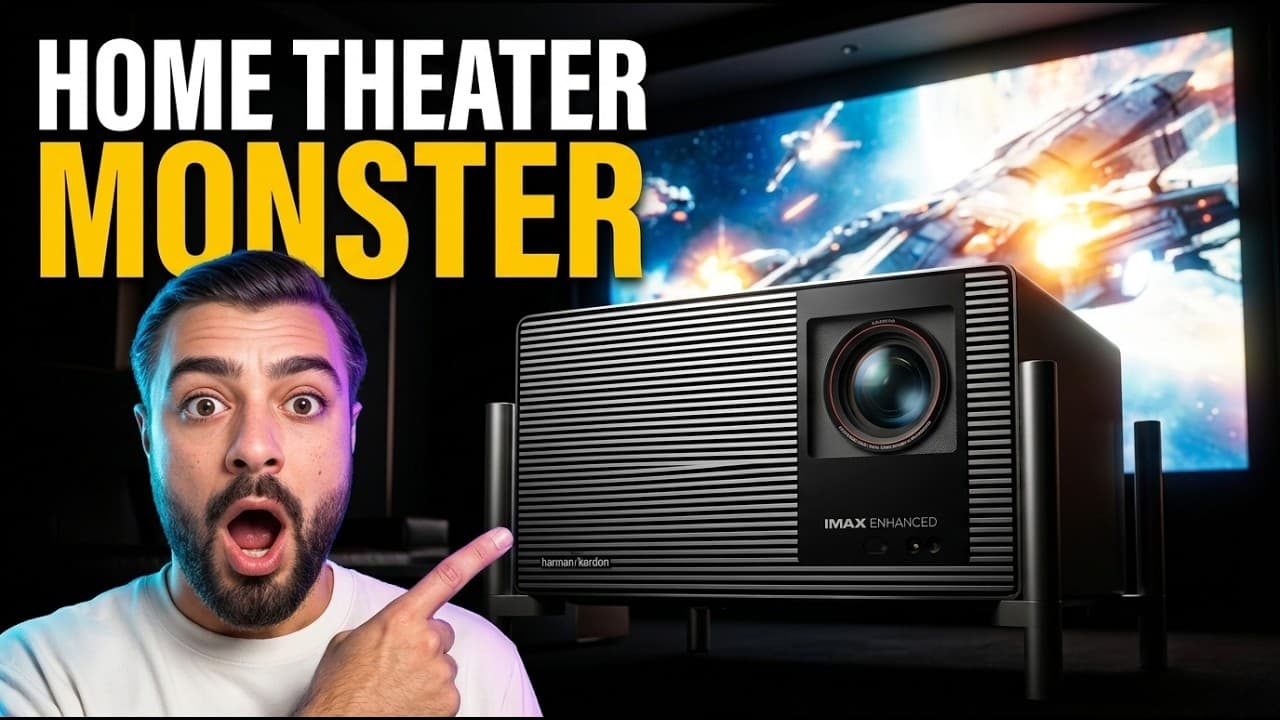
XGIMI TITAN Noir Max Review: 4K Laser Cinema
I tested the XGIMI TITAN Noir Max on a bare wall with 4K remuxes and an RTX 5090. Here is how the dual iris, 7,000 ISO lumens, and XGIMI OS actually hold up.
Bekijk de video op YouTubeThe XGIMI TITAN Noir Max only makes sense once you understand what it is built for. If you want a small smart box that boots into Netflix with a tiny remote, this is the wrong machine. When you feed this projector high-bitrate media through a proper source, it delivers contrast, color depth, and brightness that easily beat any consumer projector I have run in my studio.
On paper, the claims are extreme: 7,000 ISO lumens, RGB triple laser projection, native 10,000:1 contrast, Delta E under 0.8, and 1080p gaming at 240Hz with 1ms response times. Specs on paper do not mean much until you turn the lights off. When I checked the Kickstarter campaign on 30 April 2026, the TITAN Noir Max carried a pledge price of $2,999, against an eventual retail MSRP of $5,999. In the same lineup, the standard TITAN Noir was listed at $2,499 ($3,999 MSRP) and the TITAN Noir Pro was $2,699 ($4,999 MSRP). Those are high figures, so I wanted to see if the hardware justified them.
How the hardware and unboxing set the tone
Delivery day was an ordeal in itself. The courier could not find my apartment door, so I had to sprint down from my balcony to grab the package from the street. The sheer mass of the outer shipping crate told me right away that this was not a standard portable projector. As I said in the video, "XGIMI did not just ship a projector here. They shipped an experience."
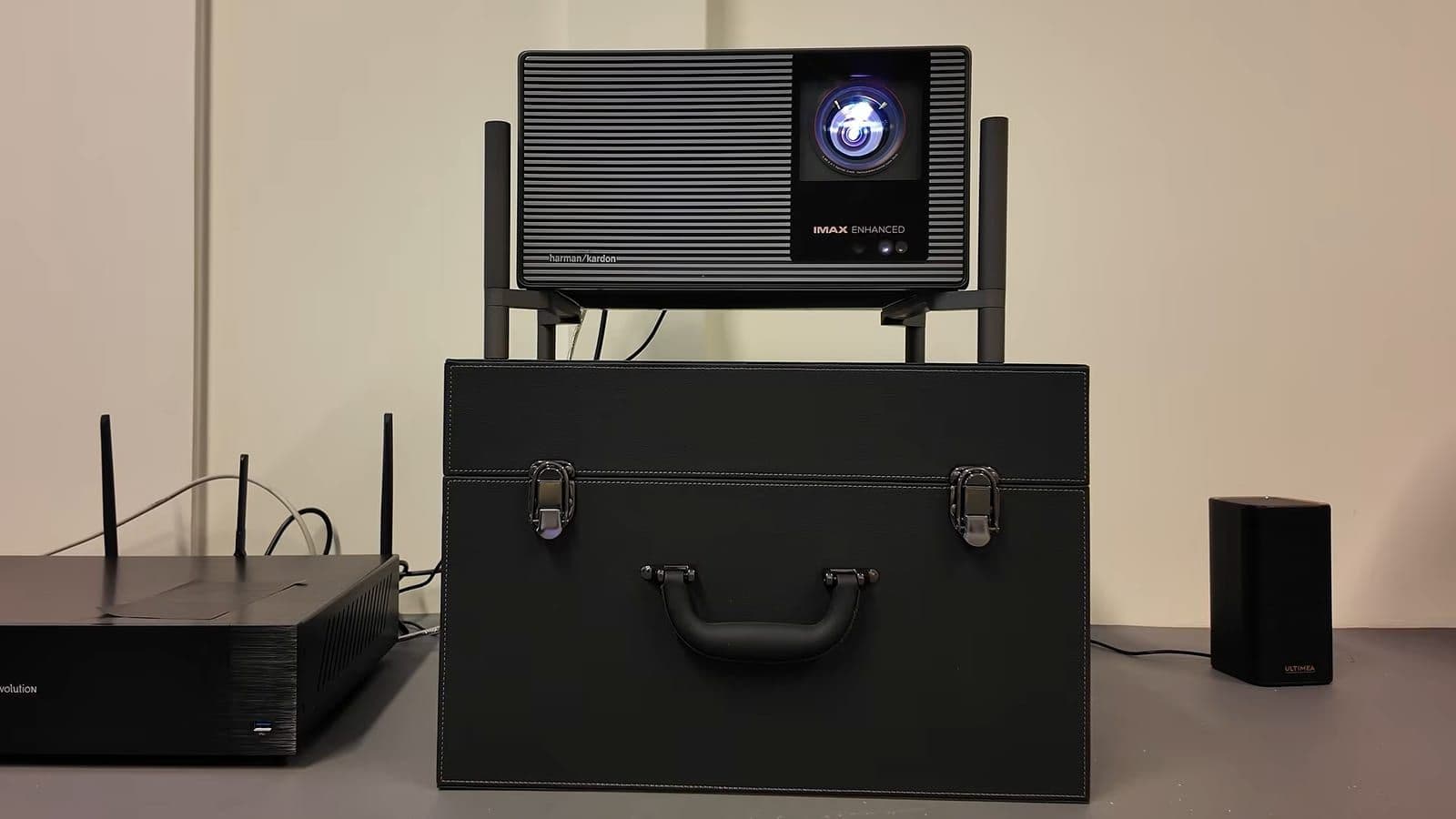
Inside the box, you do not get standard Styrofoam inserts. You get a heavy, leather-style suitcase with metal latches and a reinforced handle. Because I did not have a dedicated projection stand ready in my room, that suitcase immediately doubled as my projector table. It is solid enough to support the machine with zero wobble.
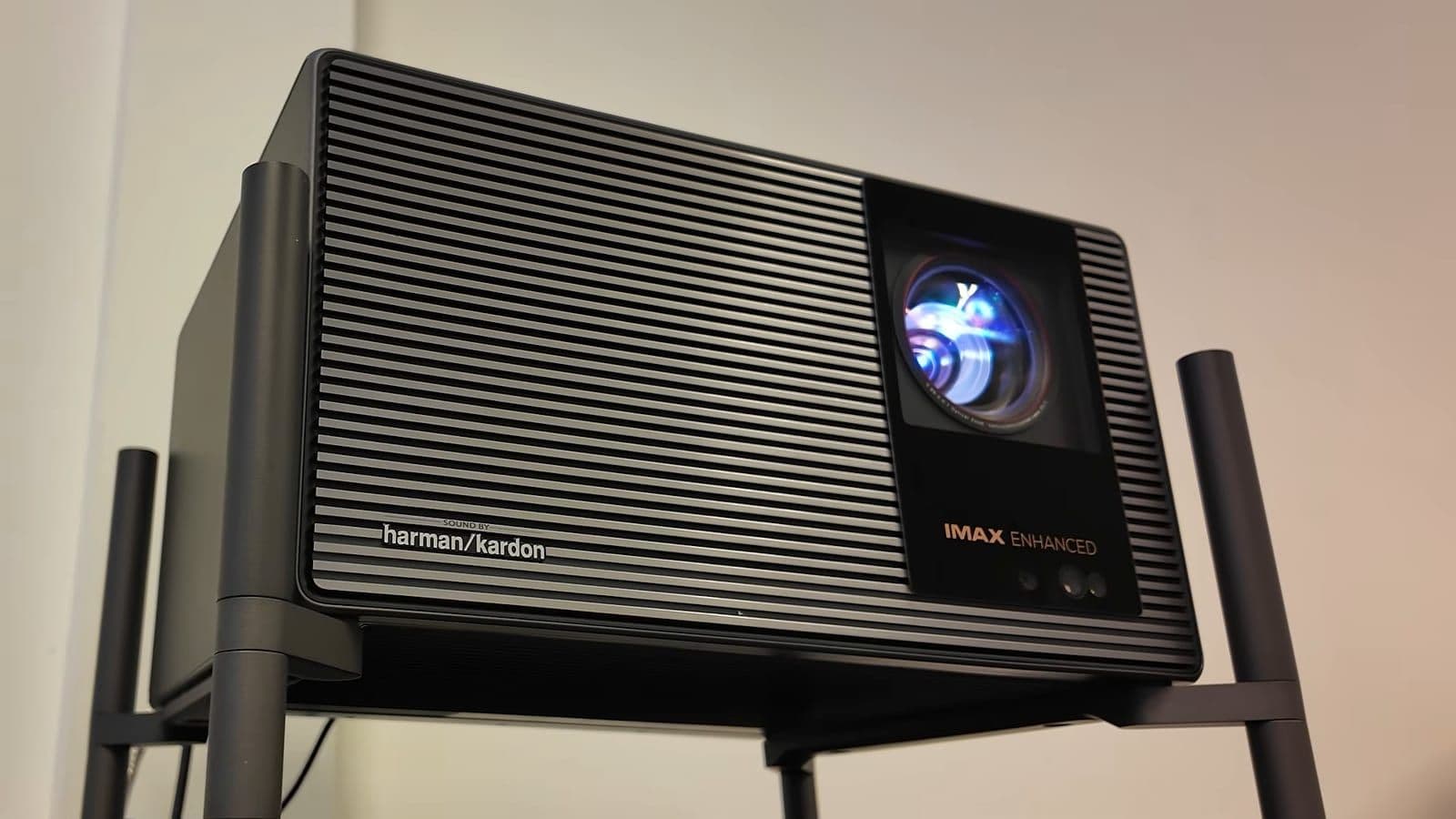
The projector itself carries a dark, industrial look dominated by a massive glass lens element. It is easily one of the largest lenses I have ever seen on a home projector, framed beside an IMAX Enhanced badge and Harman Kardon branding. Around the back, the connection layout is completely practical:
- Three HDMI inputs
- Gigabit RJ45 Ethernet port
- Optical digital audio output
- USB ports
- 3.5mm analog audio jack
- Standard AC power input
The remote is the one area where my impressions were mixed. It features four customizable shortcut keys, which I like. But in 2026, I do not want to put AAA batteries into a flagship remote, and the lack of full backlighting makes dark-room navigation clunky.
Why running XGIMI OS changes how you should use it
When I first powered the unit on, I expected standard Google TV or Android TV like on my Horizon 20 Max. Instead, the unit boots into proprietary XGIMI OS. For a casual buyer expecting built-in streaming apps out of the box, that might feel like an annoying omission.
Yet the moment I went through the menus, the choice made complete sense. As I noted during testing, "This does not feel like a projector built mainly for casual streaming. It feels like a serious, picture-first machine..." XGIMI stripped out the bloated TV operating system to dedicate the processing power to pure optical calibration and image rendering.
Setting up the picture is straightforward because the mechanical controls do the heavy lifting. You get motorized optical lossless zoom, optical lens shift (up to +130% vertically and +50% horizontally), digital displacement, and keystone adjustments. Because the motors move the physical lens optics inside the chassis, you avoid the severe digital degradation and light halos common on cheaper digital keystone projectors. The intelligent eye protection also has a clever localized Follow Mode. When someone walks in front of the lens, the projector only dims the exact area where the person is standing, keeping the rest of the movie playing normally.
Picture quality on a bare wall and why bitrate matters
Most projector reviews test against expensive ambient light rejecting screens. I took a different route. As I put it, "A white wall isn't the easy test. A projector screen is the easy test." I threw the image directly onto a plain white apartment wall using the upcoming R_volution PlayerPro 8K TV as my media source.

Projectors of this caliber expose every flaw in your video source. Standard 4K streams from Netflix or Disney+ deliver around 15 to 25 Mbps, which often shows macroblocking in shadows and color banding in gradients. "And to my eyes, the difference between watching a Netflix stream and watching a proper movie remux file on a projector like this is personally just huge."
When I played uncompressed remux files, like a 73 GB copy of Mission: Impossible Dead Reckoning, a 67 GB file of F1 The Movie, and a 63 GB file of Avengers, the picture transformed completely. The 7,000 ISO lumens combined with the RGB triple laser source delivered rich saturation, razor-sharp detail, and clean highlights without looking blown out. Even in a daylight room with the blinds cracked open, the image maintained solid clarity.
How the dual intelligent iris changes black levels
Projectors usually force you to choose between high brightness or deep black levels. The TITAN Noir Max solves this with a motorized Dual Intelligent Iris system. You can let the software adjust dynamically, or you can step through manual stops between f/2.0 and f/7.0 directly from the quick menu.
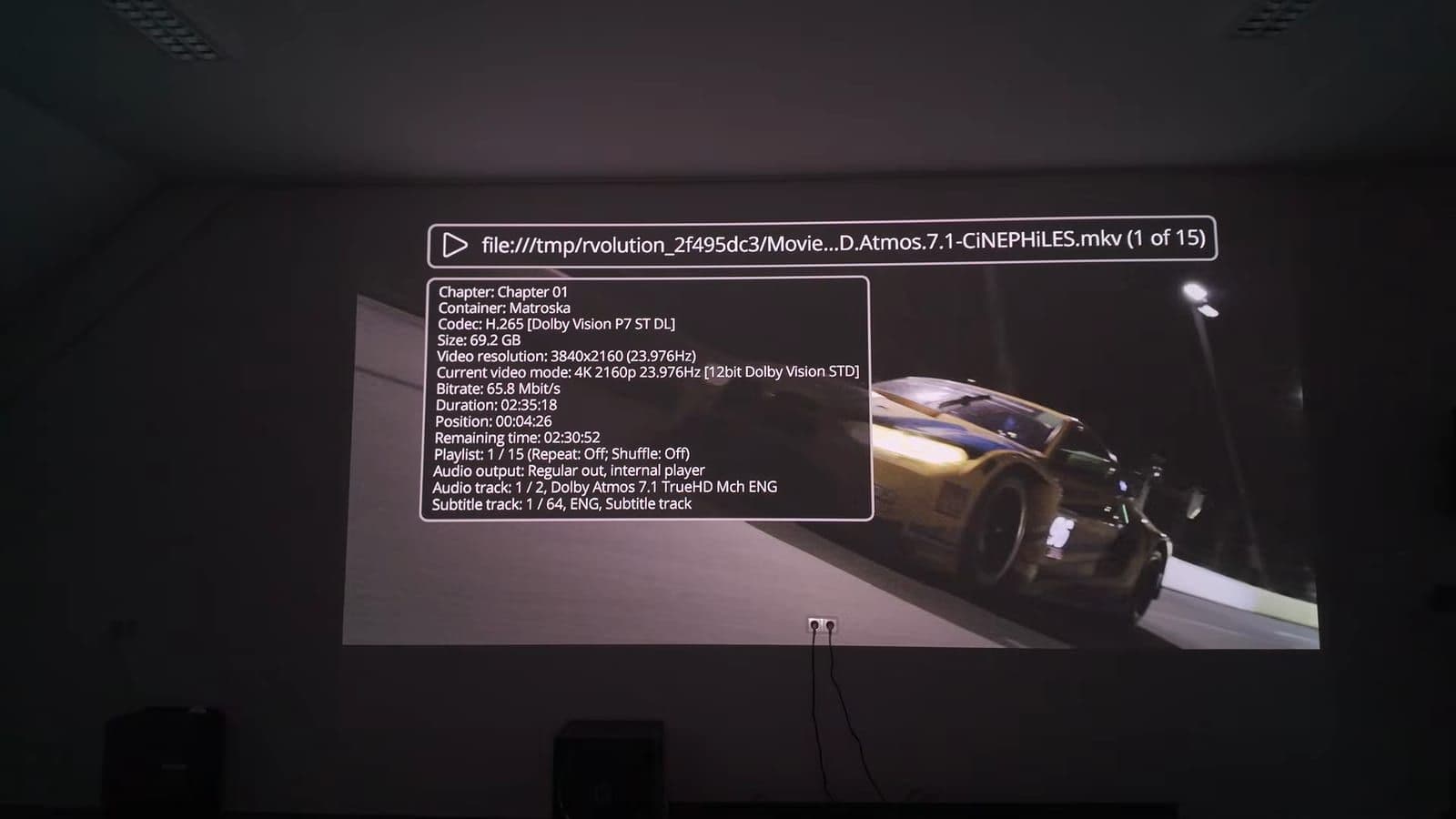
Closing the iris down toward f/7.0 narrows the aperture, which significantly drops the black floor. Dark night scenes in racing movies gained genuine shadow detail instead of turning into muddy gray haze. Opening it up toward f/2.0 lets the full 7,000 lumens rip through the lens, giving outdoor scenes intense dynamic punch. Having physical mechanical control over your contrast floor makes adapting the projector to changing ambient light simple.
The built-in Harman Kardon audio system was another genuine surprise. I keep a dedicated Skywave sound system nearby, but the onboard speakers filled the room with crisp dialogue and noticeable low-end weight. Friends who dropped by while the projector was running honestly assumed my external surround setup was turned on.
Gaming on an RTX 5090 at 240Hz
I hooked up a gaming desktop running an Nvidia GeForce RTX 5090 to test the low-latency claims. Home theater projectors are notorious for sluggish input lag, but the TITAN Noir Max supports Auto Low Latency Mode, Variable Refresh Rate, and 1080p output at up to 240Hz.
Playing Call of Duty Warzone and Forza Horizon on a massive wall felt shockingly responsive. Input response felt immediate, with none of the rubber-banding latency that usually ruins projector gaming. As I pointed out in my testing, "It's not about replacing a desk monitor for sweaty competitive sessions. It is about taking already fun games and making them feel massive." The fast laser response eliminates motion blur, making high-speed turns feel clean.
Who should buy the XGIMI TITAN Noir Max and who should skip it
If you want to support the project, you can find the campaign through the XGIMI Kickstarter link. You can also browse my daily production gear over at the ZinoNetic tech store.
Buy this projector if:
- You run a dedicated media player like an Apple TV 4K, Nvidia Shield, or high-end disc ripper.
- You want deep mechanical black floor control via optical lens shift and an adjustable dual iris.
- You want big-screen gaming with high refresh rates and zero noticeable control lag.
- You care about raw optical performance and high-bitrate playback above all else.
Skip this projector if:
- You want an all-in-one smart bedroom projector with native Google TV and Netflix built right into the OS.
- You are on a strict budget and do not want to back crowdfunding hardware.
- You only watch compressed, low-bitrate video streams on phone-tethered apps.
Frequently asked questions
Does the XGIMI TITAN Noir Max come with Google TV built in?
No, the projector runs proprietary XGIMI OS focused on hardware calibration and optical controls. You will need an external device like an Apple TV, Fire TV Stick, or 4K Blu-ray player to stream your content.
What is the advantage of the Dual Intelligent Iris system?
The mechanical iris allows you to physically open or close the lens aperture between f/2.0 and f/7.0. This lets you lower the black floor for deep contrast in dark rooms or open the aperture completely for maximum lumen output in brighter rooms.
Can you game competitively on the XGIMI TITAN Noir Max?
Yes, it supports 1080p at 240Hz with VRR, ALLM, and response times down to 1ms. While it will not replace an esports desktop monitor, it is easily one of the fastest and most responsive home theater projectors I have tested.